WAVE WASHER PRELOAD
파형과 조립 높이에서 베어링 예압 검증까지
WAVE WASHER PRELOAD
얇은 판재의 파형, 실제 장착 공간과 외륜의 움직임을 함께 살펴 조립 상태에서 필요한 예압을 검토합니다.
FORM · WORKING HEIGHT · PRELOAD · VERIFICATION
웨이브 와셔는 모터 안에서 눈에 잘 띄지 않는 부품입니다. 하지만 베어링 옆의 얇은 링이 얼마나 눌려 있는지에 따라 축방향으로 전달되는 힘이 달라집니다. 같은 베어링과 같은 와셔를 사용해도 엔드 커버의 위치나 조립 치수가 달라지면 회전 소음과 저항이 달라질 수 있는 이유입니다.
그래서 웨이브 와셔는 외경과 내경이 맞는지만 보고 선택하기 어렵습니다. 자유 상태의 높이, 조립 후 남는 높이, 그 높이에서의 하중을 함께 읽어야 합니다. 이 글은 세 개의 파형을 프레스 성형한 폐쇄형 판재 와셔를 중심으로, 부품의 형상에서 실제 모터의 예압 검증까지 이어지는 관계를 살펴봅니다.
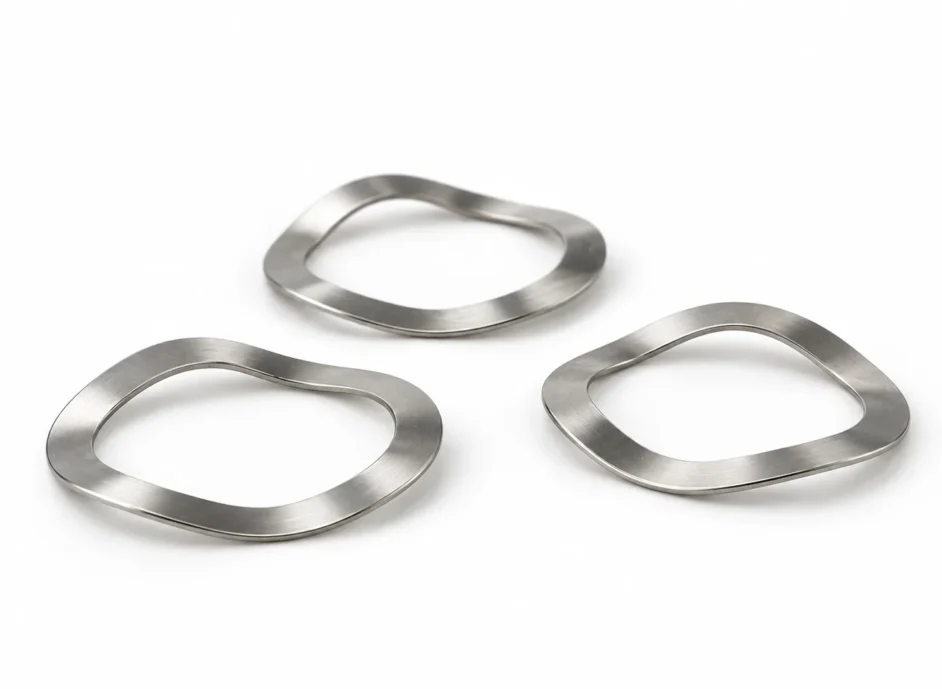
SIZE & PROFILE / 크기와 파형 높이가 다른 폐쇄형 웨이브 와셔
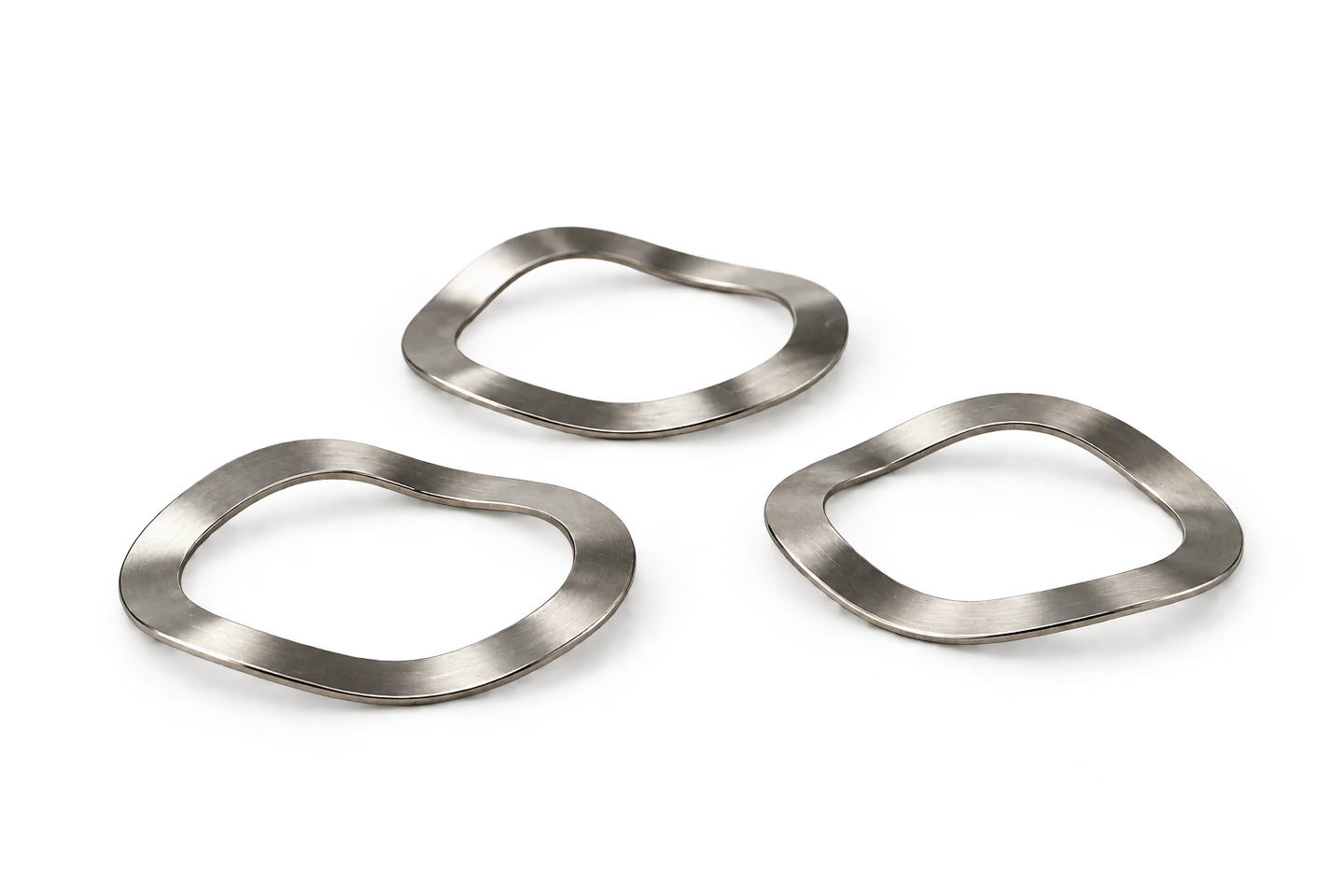
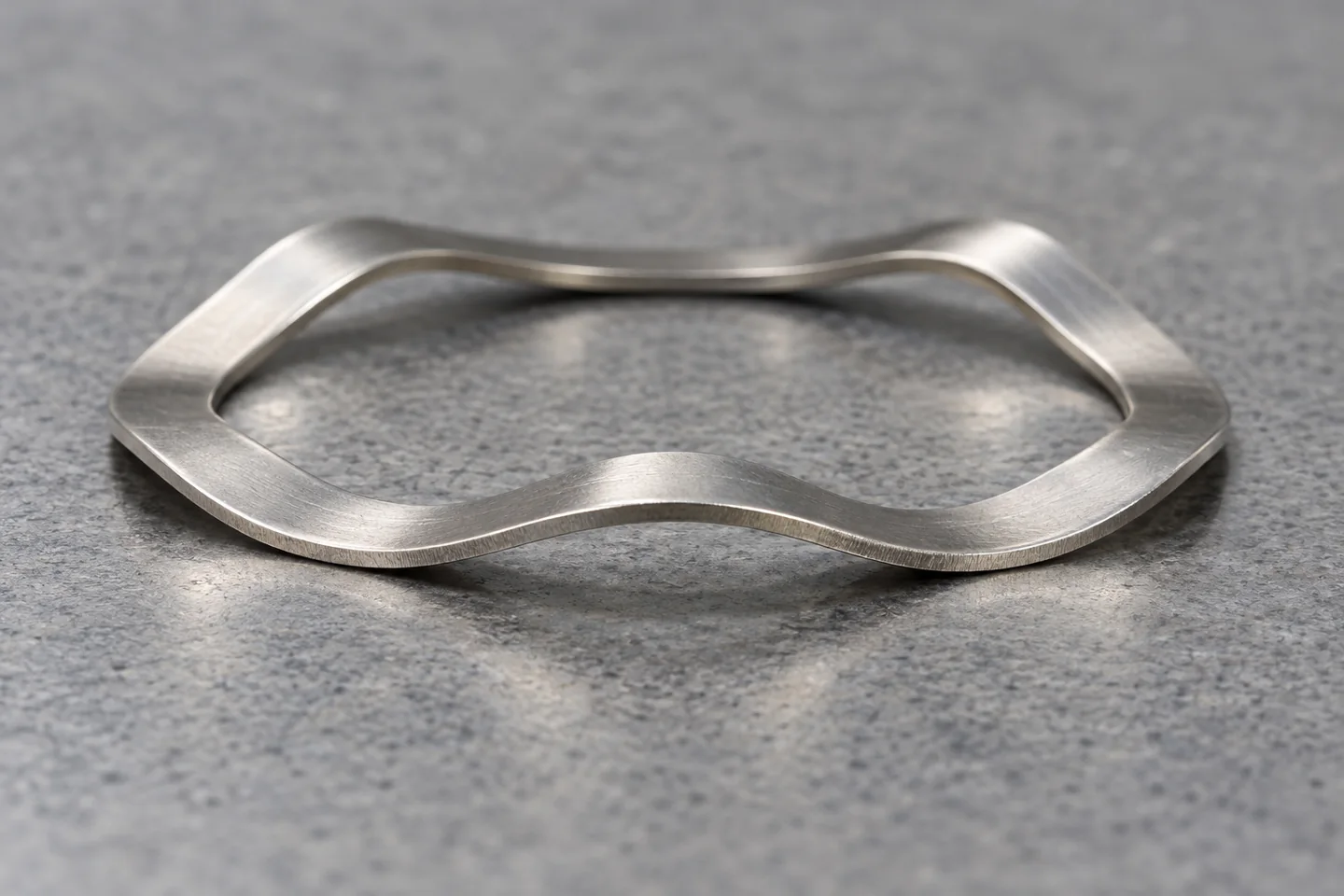
평와셔는 주로 체결면을 받치거나 간격을 만드는 데 쓰입니다. 웨이브 와셔에는 원주를 따라 높고 낮은 부분이 이어져 있습니다. 두 면 사이에서 이 파형이 눌리면 판재가 탄성 변형하며 반력을 만듭니다. 여기서 다루는 형상은 절개나 겹침이 없는 한 장의 링에 세 개의 파형을 만든 형태입니다.
그 힘은 한 점에서 갑자기 생기지 않습니다. 처음에는 높은 부분부터 상대 면에 닿고, 압축이 진행되며 접촉 상태와 변형 분포가 달라집니다. 따라서 자유 높이가 같아도 파형의 균일도나 판 두께, 링 폭이 다르면 같은 조립 높이에서 하중이 달라질 수 있습니다.
모터 베어링에 사용하는 목적은 조립 틈을 무조건 강하게 밀어 없애는 데 있지 않습니다. 정해진 운전 조건에서 필요한 축방향 하중을 유지하면서 치수 변화에 대응할 여유를 두는 것입니다. 예압을 지나치게 높이면 마찰과 발열이 증가할 수 있으므로, 소음이 줄었다는 결과만으로 더 큰 하중을 선택하지 않습니다.
파형이 있다는 이유로 모든 웨이브 스프링의 사양을 서로 바꿔 쓸 수는 없습니다. 개방형 권선 스프링이나 다회전 스프링은 끝단과 변형 방식이 다릅니다. 부품 도면과 시험값을 비교할 때도 폐쇄형 프레스 와셔인지 먼저 확인해야 합니다.
FORMED PROFILE / 연속된 링의 파형과 판재 가장자리
자유 높이 H₀는 외력이 없는 와셔의 전체 축방향 높이입니다. 조립 높이 H는 와셔가 실제로 끼워진 두 접촉면 사이의 거리입니다. 두 높이를 같은 기준으로 정의하면 압축 변위는 δ = H₀ − H로 표현할 수 있습니다. 하우징의 전체 깊이나 커버 두께를 그대로 H로 넣는 계산은 이 관계와 다릅니다.
예를 들어 도면상 조립 공간을 줄이면, 같은 자유 높이의 와셔는 더 많이 눌립니다. 다만 얼마나 큰 힘이 증가하는지는 해당 부품의 하중–높이 곡선이 알려 줍니다. 얕게 눌린 구간, 파형이 고르게 지지되는 구간, 평탄에 가까운 구간을 하나의 스프링 상수로 모두 설명하면 실제 하중을 잘못 예상할 수 있습니다.
사양에는 외경·내경·두께와 함께 지정 높이에서의 하중 허용범위가 필요합니다. 조립 높이가 움직이는 제품이라면 한 높이의 검사값뿐 아니라 실제 사용 구간에서의 곡선도 봅니다. 자유 높이는 형상 관리에 유용하지만, 그것만 합격이라고 해서 기능 하중까지 합격이라고 할 수는 없습니다.
작동 여유도 같은 곡선 안에서 정합니다. 조립 편차가 커지는 쪽에서는 필요한 최소 하중을 유지해야 하고, 더 눌리는 쪽에서는 허용 하중과 변형 한계를 넘지 않아야 합니다. 완전히 납작해질 때까지의 거리를 모두 사용 가능한 스트로크로 잡지 않는 이유입니다.
| 항목 | 기준 | 연결해서 볼 값 |
|---|---|---|
| 자유 높이 H₀ | 하중을 가하지 않은 전체 높이 | 파형의 균일도·잔류 변형 |
| 조립 높이 H | 와셔를 직접 누르는 두 접촉면 간 거리 | 치수 누적·온도에 따른 변화 |
| 검사 높이 Hₜ | 하중 검사에 정해 둔 압축 높이 | 해당 높이의 하중 허용범위 |
기준 · 연결해서 볼 값
파형이 낮아지면서 자유 높이와 조립 높이의 차이가 커집니다. 점선은 자유 높이이며, 압축판의 앞쪽은 내부를 볼 수 있도록 절개했습니다.
와셔가 눌려 있다는 사실만으로 베어링 예압이 정해지지는 않습니다. 힘이 전달되는 외륜, 전동체, 내륜과 축의 지지 관계를 함께 봐야 합니다. 한 가지 모터 배열에서는 축방향으로 이동할 수 있는 비회전 외륜의 측면을 스프링으로 밀어 베어링 계통에 하중을 줍니다. 이때 외륜은 해당 설계가 요구하는 만큼 실제로 움직일 수 있어야 합니다.
하우징 끼워맞춤이 너무 빡빡하거나 어깨·고정링이 이동을 막으면, 와셔의 힘 일부가 의도하지 않은 경로로 전달될 수 있습니다. 접촉 마찰 때문에 조립 직후와 한 번 움직인 뒤의 상태가 달라질 수도 있습니다. 부품 단독 하중과 조립체의 실제 예압을 구분해야 하는 지점입니다.
와셔가 닿는 면도 중요합니다. 외륜에 힘을 주는 구조라면 지지 폭을 외륜 측면에 맞추고, 실드·씰이나 회전하는 내륜과 간섭하지 않게 검토합니다. 압축 과정에서 링의 내·외경이 달라질 수 있으므로, 자유 상태의 여유뿐 아니라 눌린 상태의 간섭도 확인합니다.
고정측과 자유측의 역할, 두 베어링의 배열, 외부 축하중이 달라지면 필요한 설계도 달라집니다. 특히 양방향으로 큰 추력이 반복되는 장치에 작은 와셔를 넣는 것만으로 축 위치를 안정시킬 수는 없습니다. 베어링 제조사의 적용 조건을 기준으로 하중 경로와 허용 이동량을 먼저 정합니다.
축방향 힘은 커버 → 와셔 → 자유측 외륜 → 전동체·내륜 → 축 어깨 → 고정측 베어링 → 하우징으로 이어집니다. 화살표는 경로를 나타냅니다.
조립 높이는 보통 한 부품의 치수로 결정되지 않습니다. 엔드 커버의 위치, 베어링 폭, 축 어깨와 하우징 기준면, 스페이서나 고정 부품이 하나의 치수 관계를 만듭니다. 도면에서는 와셔를 직접 누르는 두 면까지의 경로를 따라가며 어떤 치수가 공간을 늘리고 줄이는지 부호를 붙여 정리합니다.
공간이 가장 크게 남는 조합과 가장 작게 남는 조합을 실제 하중 곡선에 대입하면, 같은 품번의 와셔에서도 어느 범위의 힘이 생길지 검토할 수 있습니다. 중요한 것은 공차를 더한 숫자를 만드는 데 그치지 않고, 그 끝점이 필요한 하중 범위 안에 들어오는지 확인하는 것입니다. 조립부의 탄성 변형이 무시할 수 없으면 와셔와 다른 부품이 변위를 나누어 갖는 관계도 포함합니다.
운전 중에는 축과 하우징의 온도가 같지 않을 수 있습니다. 재료의 팽창률과 길이, 온도 분포, 고정 위치가 함께 작용하므로 온도가 오르면 와셔가 반드시 더 눌린다고 정할 수 없습니다. 실제 배치에서 장착 공간이 어느 방향으로 바뀌는지 계산하고 냉간·열안정 상태에서 대조합니다.
스프링 예압은 치수 변화에 대한 하중의 민감도를 줄이는 데 쓰이지만, 힘이 완전히 일정하다는 뜻은 아닙니다. 마찰과 온도에 따른 재료 특성 변화, 장시간 압축 후의 하중 유지까지 포함해 남는 여유를 봅니다. 하나의 상온 검사값을 모든 운전 상태의 예압으로 사용하지 않습니다.
| 상태 | 볼 것 | 판단 |
|---|---|---|
| 공간이 큰 공차 조합 | 가장 덜 눌린 상태의 하중 | 필요한 하중을 유지하는가 |
| 공간이 작은 공차 조합 | 최대 압축과 간섭 여유 | 허용 하중·변형 안에 있는가 |
| 열안정 운전 | 축·하우징의 상대 이동과 실제 온도 | 작동 구간을 벗어나지 않는가 |
| 반복 운전 뒤 | 같은 높이에서의 하중과 잔류 높이 | 기능과 하중이 유지되는가 |
볼 것 · 판단
폐쇄형 웨이브 와셔는 판재에서 링을 타발하고 파형을 성형합니다. 구체적인 공정 순서와 열처리·후처리는 소재의 공급 상태와 요구 특성에 맞춰 정합니다. 외형이 단순해 보여도 두께와 경도, 파형 높이와 위치가 함께 반력에 영향을 주므로 치수 하나를 조정해 모든 편차를 해결하기는 어렵습니다.
세 개의 파형이 고르게 만들어져야 지지면에 닿는 과정도 재현됩니다. 한 부분만 유난히 높거나 비틀리면 초기 압축에서 기울어짐과 하중 편차가 나타날 수 있습니다. 타발 가장자리의 버와 흠집, 성형부 균열도 검사 대상입니다. 특히 접촉면에 남은 버가 측정 기준이나 조립면을 바꾸지 않는지 봅니다.
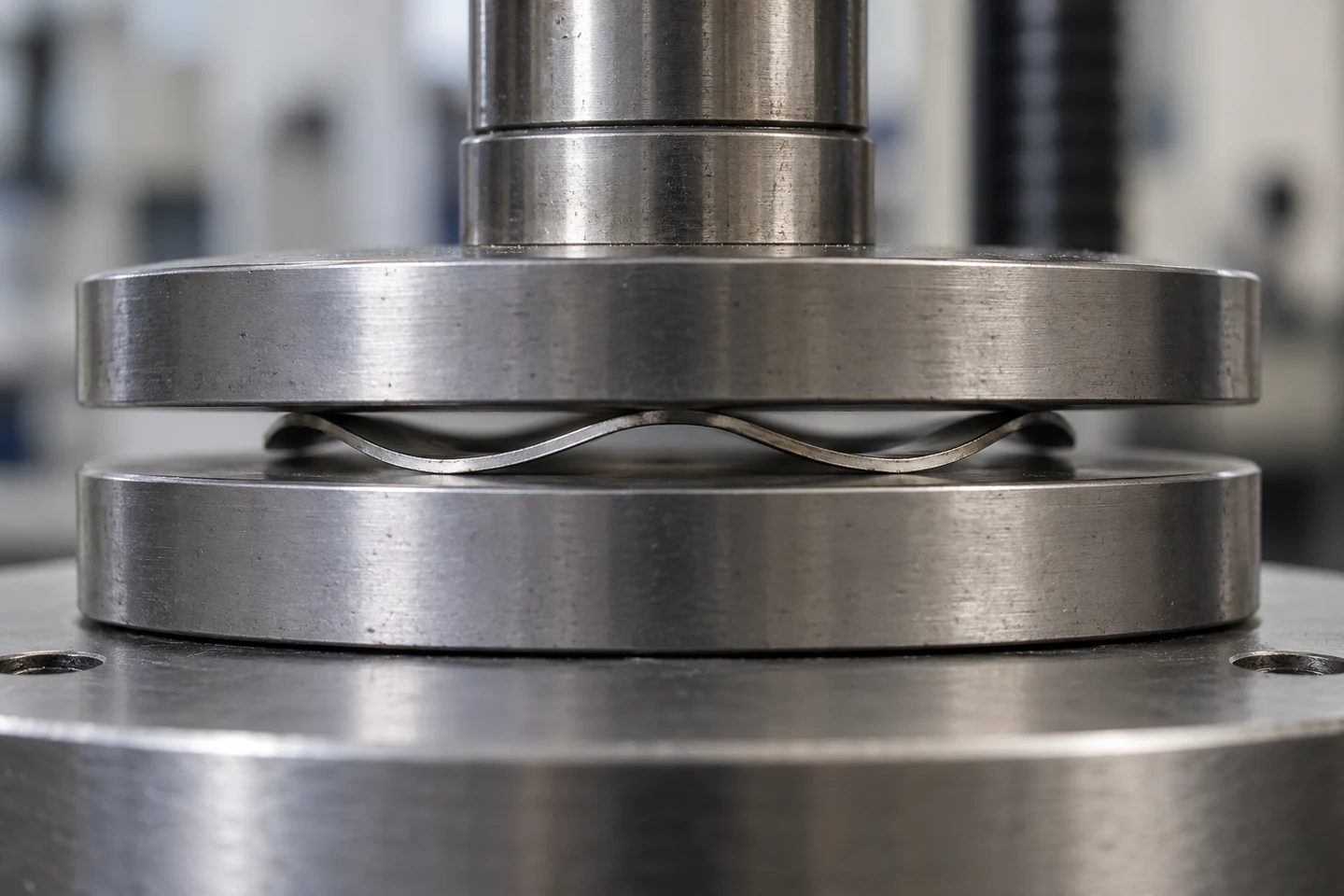
완성품 검사는 두 가지 질문을 나누어 답해야 합니다. 먼저 재질·두께·직경·파형이 도면에 맞는지 확인합니다. 다음으로 지정 높이에 눌렀을 때 필요한 하중이 나오는지 측정합니다. 이때 시험기의 평행한 가압면, 중심 위치, 초기 접촉 기준, 가압 속도와 사전 압축 조건을 일정하게 두어야 로트 간 비교가 가능합니다.
압축 후 다시 꺼냈을 때의 높이와 같은 높이에 재압축한 하중도 도움이 됩니다. 높이가 돌아오지 않는 영구 변형과, 높이를 유지한 상태에서 시간이 지나며 힘이 줄어드는 응력 이완은 서로 다른 현상입니다. 실제 사용 온도·시간·반복 횟수에 맞춘 시험으로 구분하며, 서로 다른 재질의 결과를 외형만 보고 대신 적용하지 않습니다.
LOAD AT HEIGHT / 정해진 높이에서 하중을 확인하는 압축 검사
부품 검사를 통과한 뒤에는 모터에서 확인할 차례입니다. 조립 높이와 축방향 이동, 회전 저항, 운전 소음·진동, 베어링 부근 온도를 연결해 봅니다. 마찰 토크에는 그리스와 씰의 영향도 포함되므로, 토크가 높다는 사실만으로 와셔 하중을 단정하지 않습니다. 측정 위치와 조건을 맞춘 비교가 필요합니다.
처음 돌렸을 때 조용하더라도 열이 오른 뒤에는 하중 상태가 달라질 수 있습니다. 기동·정지와 열안정 운전을 나누어 보고, 설계한 온도 범위에서 축방향 이동이 막히거나 작동 높이가 한계에 가까워지는지 확인합니다. 반대로 소음이 커졌다면 예압 부족만 의심하기보다 끼워맞춤, 정렬과 다른 진동원도 함께 검토합니다.
변경품 비교에서는 와셔 품번과 로트, 실측 조립 높이, 베어링과 윤활 조건을 함께 남기는 편이 원인을 찾기 쉽습니다. 커버나 스페이서가 바뀌었는데 와셔만 동일하다는 이유로 이전 시험 결과를 그대로 적용하면 하중 변화가 가려집니다. 도면의 치수 관계가 달라졌다면 하중 곡선 위의 작동 위치도 다시 확인합니다.
웨이브 와셔의 설계는 파형을 만드는 일에서 끝나지 않습니다. 실제 장착 높이에서 발생하는 힘이 의도한 베어링 경로로 전달되고, 운전 중에도 필요한 범위에 머무는지 확인할 때 얇은 프레스 부품의 역할이 분명해집니다.
궁금한 사항은 아래 문의 양식으로 남겨 주세요.
Please use the form below to send your enquiry.
WAVE WASHER PRELOAD
Consider the sheet-metal waveform, available installation space and outer-ring movement together when reviewing the preload in the assembly.
FORM · WORKING HEIGHT · PRELOAD · VERIFICATION
ENGLISH EDITION
A small change in installed height changes the force transmitted to the bearing.
A wave washer is easy to overlook inside a motor. Yet the compression of this thin ring beside the bearing changes the axial force it transmits. Even with the same bearing and washer, a different end-cover position or assembly dimension can change rotational noise and resistance.
Matching the outside and inside diameters is therefore only the beginning. Free height, installed height and the load at that height must be considered together. This article follows a closed, three-wave sheet-metal washer from its stamped geometry to preload verification in the motor assembly.
SIZE & PROFILE / Closed wave washers with different diameters and wave heights
A flat washer mainly supports a seating surface or establishes spacing. A wave washer has alternating high and low regions around its circumference. Compression between two surfaces elastically deforms the sheet and develops a reaction force. The form discussed here is one continuous ring with three waves and no split or overlap.
That force does not appear at a single fixed contact condition. The high regions seat first; contact and deformation then evolve as compression continues. Washers with equal free heights can consequently deliver different loads at the same installed height when thickness, radial width or wave uniformity differs.
In a motor bearing arrangement, the aim is to maintain the required axial load while allowing for dimensional change. It is not to remove every gap with the greatest available force. Excessive preload can increase friction and heat, so a quieter initial run is not by itself a reason to specify a higher load.
A wavy appearance does not make different spring constructions interchangeable. Open wound springs and multiple-turn springs have different end conditions and deformation behaviour. Establish that a part is a closed stamped washer before comparing its drawing and test data with this arrangement.
FORMED PROFILE / Wave geometry and edges of a continuous ring
Free height H₀ is the overall axial height of the unloaded washer. Installed height H is the distance between the two surfaces actually contacting it. With consistent reference surfaces, compression is δ = H₀ − H. Substituting the full housing depth or cover thickness for H does not describe the same dimension.
Reducing the installation space compresses a washer of the same free height further. The resulting force change must come from that part’s load–height curve. Initial seating, more fully supported deformation and the near-flat region should not automatically be represented by one spring rate.
A specification therefore needs a permitted load range at a defined height alongside diameter and thickness. If installed height varies in service, review the curve across the operating interval as well as the inspection point. Free height is a useful geometry check, but a passing free-height measurement does not establish a passing functional load.
Define travel margin within the same curve. At the larger installation-space limit, the washer must still supply the necessary minimum load. At the smaller-space limit, it must remain within the allowed load and deformation limits. The entire distance to a fully flat condition is not automatically usable travel.
| Item | Reference | Associated value |
|---|---|---|
| Free height H₀ | Overall unloaded height | Wave uniformity and permanent set |
| Installed height H | Distance between the two contacting surfaces | Tolerance accumulation and temperature effects |
| Test height Hₜ | Compression height specified for inspection | Permitted force at that height |
Reference · Associated value
Reducing wave amplitude increases the difference between free and installed height. The dashed line marks free height; the front of the upper platen is sectioned for visibility.
A compressed washer does not by itself define bearing preload. Follow the support relationships through the outer ring, rolling elements, inner ring and shaft. One motor arrangement applies the spring to the side of a non-rotating outer ring that can move axially. That ring must actually retain the movement required by the design.
An overly tight housing fit or an obstructing shoulder or retaining ring can divert force away from the intended path. Friction can also make the condition immediately after assembly different from the condition after movement. This is why isolated washer force and mounted bearing preload are separate quantities to verify.
The contact surface matters as well. Where the outer ring is loaded, align the support width with its side face and check clearance from the shield, seal and rotating inner ring. Ring diameters can change during compression, so inspect interference in the compressed state as well as clearance in the free state.
The locating arrangement, bearing pair and external axial loads determine what design is appropriate. A small washer alone cannot establish precise shaft location under substantial reversing thrust. Define the force path and permitted movement using the bearing manufacturer’s application requirements.
The axial path runs from cover to washer, nonlocating outer race, rolling elements and inner race, shaft shoulders, locating bearing and housing. Arrows show the path.
Installed height rarely comes from one component dimension. The end-cover position, bearing width, shaft shoulders, housing references, spacers and retainers form a dimensional chain. Trace that chain to the two washer-contacting surfaces and identify which dimensions increase or decrease the available space.
Apply the largest-space and smallest-space combinations to the actual load curve to review the resulting force interval. The objective is not merely to calculate a tolerance sum, but to establish whether its endpoints remain inside the required load range. Where other components deform significantly, include how the washer and those components share displacement.
The shaft and housing may operate at different temperatures. Expansion coefficients, effective lengths, temperature distribution and locating positions act together. Heating therefore does not universally mean greater washer compression. Determine the direction of space change for the actual arrangement and compare cold and thermally stabilised conditions.
Spring preloading reduces sensitivity to dimensional movement; it does not make force perfectly constant. Review the remaining margin with friction, temperature-dependent material behaviour and load retention after sustained compression. One room-temperature inspection point cannot represent preload in every operating condition.
| State | Review | Decision |
|---|---|---|
| Largest tolerance space | Force at minimum compression | Is the required load retained? |
| Smallest tolerance space | Maximum compression and interference margin | Are load and deformation acceptable? |
| Thermally stable operation | Relative shaft–housing movement and measured temperature | Does it remain within the working interval? |
| After repeated operation | Force at the same height and residual free height | Are function and force retained? |
Review · Decision
A closed wave washer is produced by blanking a ring from sheet and forming the wave profile. The detailed sequence and thermal or surface treatments depend on the material condition and required properties. Thickness, hardness and wave height and position all influence reaction force, so adjusting one dimension cannot resolve every source of variation.
Consistent waves help reproduce the seating process. A locally high or twisted region can introduce tilting and force variation during initial compression. Inspect blanked edges for burrs and damage and formed areas for cracks. A burr on a contact region must not change the measurement reference or assembly seating condition.
Finished-part inspection answers two questions. Do material, thickness, diameters and formed geometry meet the drawing? Does the part then deliver the required force at the specified height? Parallel loading faces, centring, initial contact definition, compression speed and any preconditioning need consistent test conditions for meaningful lot comparisons.
Free height after unloading and force on re-compression provide further information. Permanent set, where the original height is not recovered, differs from stress relaxation, where force falls over time at a maintained height. Evaluate these against the intended temperature, duration and cycling conditions. Similar geometry does not make data from another material interchangeable.
LOAD AT HEIGHT / Compression inspection at a defined working height
After part inspection, verify the motor. Relate installed height and axial movement to rotational resistance, running noise and vibration, and temperature near the bearing. Grease and seals also contribute to friction torque, so a high torque reading alone does not identify washer load. Comparisons need matched measurement locations and conditions.
An initially quiet motor can develop a different load condition as it warms. Examine starting, stopping and thermally stable running separately. Across the design temperature range, check whether axial movement becomes obstructed or the working height approaches a limit. If noise rises, investigate fits, alignment and other vibration sources alongside preload.
When comparing revisions, retain the washer identification and lot, measured installation height, bearing and lubrication conditions. Reusing the same washer does not preserve the old force condition if a cover or spacer changes. A revised dimensional chain requires another check of the operating position on the load curve.
Designing a wave washer extends beyond forming its profile. Its role is established when force at the actual installed height reaches the intended bearing path and remains within the required range throughout operation.

폐쇄형 웨이브 와셔는 판재에 만든 파형의 탄성 변형으로 축방향 하중을 발생시킵니다. 모터 베어링에 적용할 때는 직경과 자유 높이뿐 아니라 실제 조립 높이의 하중, 외륜의 이동 조건과 접촉면, 공차·온도 변화에 따른 작동 구간을 함께 검토합니다. 부품의 압축 검사와 모터 조립체의 운전 검증은 서로 연결되지만 같은 시험은 아닙니다.
01 / 형상 특정 — 폐쇄형 판재 와셔와 개방형·다회전 웨이브 스프링을 구분합니다.
02 / 높이 정의 — 자유 높이 H₀와 실제 접촉면 사이 조립 높이 H를 같은 기준으로 읽습니다.
03 / 하중 곡선 — 지정 높이의 하중과 실제 사용 구간을 확인하고 단일 스프링 상수의 적용 범위를 구분합니다.
04 / 전달 경로 — 하우징 끼워맞춤과 외륜 이동, 실드·씰 간섭을 포함해 의도한 면에 힘이 전달되는지 봅니다.
05 / 공차와 열 — 가장 큰·작은 장착 공간과 냉간·열안정 상태를 하중 곡선에 연결합니다.
06 / 성형 품질 — 두께·파형의 균일도·버·균열과 지정 높이에서의 하중을 함께 관리합니다.
07 / 조립 검증 — 하중 검사 결과를 축방향 이동, 회전 저항, 소음·진동과 온도에 연결해 해석합니다.
기능이 다릅니다. 평와셔는 주로 면을 받치거나 간격을 만들고, 웨이브 와셔는 파형이 눌리며 탄성 반력을 만듭니다. 같은 직경이라도 필요한 예압과 작동 높이를 다시 검토하지 않고 대체할 수 없습니다.
자유 높이만으로 하중을 정할 수 없습니다. 판 두께와 링 폭, 재질 상태와 파형 균일도가 함께 작용합니다. 실제 장착 높이에서의 하중과 사용 구간의 곡선을 확인합니다.
이 글의 조립 높이 H는 와셔를 직접 누르는 두 접촉면 사이의 거리입니다. 하우징 깊이에서 베어링·스페이서·커버 등의 관계를 반영해야 하는 경우가 많으므로, 도면의 기준면과 치수 연결부터 확인합니다.
치수 변화에 따른 하중 변화를 줄이는 방식이라는 뜻입니다. 와셔의 하중 곡선은 위치에 따라 기울기가 달라질 수 있고, 마찰과 온도, 장시간 압축도 영향을 줍니다. 실제 작동 구간 안에서 유지되는 하중 범위로 판단합니다.
항상 그렇지는 않습니다. 축과 하우징의 재질·길이·온도 분포, 베어링 고정 위치에 따라 장착 공간이 변하는 방향이 달라집니다. 해당 배열에서 상대 이동을 계산하고 냉간과 열안정 상태를 비교합니다.
완전히 평탄해지는 상태를 일반적인 작동점으로 삼지 않습니다. 그 근처에서는 하중 특성과 변형 여유가 달라질 수 있습니다. 해당 부품의 허용 변위와 하중 범위 안에서 공차·운전 변화까지 고려해 작동 높이를 정합니다.
하중 전달 경로가 성립할 때 유용한 출발값이 됩니다. 하지만 외륜의 이동을 막는 끼워맞춤, 마찰이나 다른 지지 경로가 있으면 그대로 같다고 볼 수 없습니다. 실제 조립 조건과 베어링 배열을 함께 확인해야 합니다.
소음은 확인 항목 중 하나입니다. 회전 저항과 베어링 부근 온도, 축방향 이동, 열안정 후 상태도 함께 봅니다. 높은 예압으로 초기 소음이 줄었더라도 발열이나 수명에 불리할 수 있으므로 베어링 적용 조건과 대조합니다.
하우징의 전체 깊이보다 와셔가 직접 닿는 면을 찾는 것이 먼저입니다. 그 두 면까지의 치수 관계가 조립 높이를 결정합니다.
자유 높이와 직경이 비슷해도 판 두께·재질 상태·파형이 달라지면 반력이 달라집니다. 교체품은 지정 높이의 하중으로 비교합니다.
와셔의 하중 곡선은 부품 특성을 보여 줍니다. 실제 모터에서는 끼워맞춤과 하중 경로, 온도·회전 상태까지 연결해야 합니다.
조립 공차 누적 검토 — 기준면과 치수 연결로 조립 편차를 검토하는 관점
프레스 금형 이관 — 금형·설비 조건과 시험 생산을 연결하는 과정
웨이브 와셔베어링 예압모터 베어링프레스 성형조립 높이자유 높이하중 변위공차 누적열팽창외륜 지지하중 검사
A closed wave washer develops axial force through elastic deformation of its formed sheet-metal profile. Motor-bearing applications require more than diameter and free height: review force at the actual installed height, outer-ring movement and contact surfaces, and the working interval under tolerance and temperature changes. Washer compression testing and motor assembly verification are connected, but they answer different questions.
01 / Identify the construction — distinguish a closed stamped washer from open wound and multiple-turn wave springs.
02 / Define the heights — use consistent references for free height H₀ and the actual contact-surface spacing H.
03 / Read the force curve — verify load at the specified height and across the working interval; limit any constant-rate approximation to its applicable range.
04 / Trace the force — review housing fit, outer-ring movement and clearance from shields and seals.
05 / Connect tolerance and temperature — map largest and smallest installation spaces and cold and warm states onto the force curve.
06 / Control the formed part — assess thickness, wave uniformity, burrs and cracks together with load at height.
07 / Verify the assembly — interpret force-test results alongside axial movement, rotational resistance, noise, vibration and temperature.
They have different functions. A flat washer mainly supports a surface or establishes spacing; a wave washer develops elastic reaction as its profile compresses. Equal diameter does not justify substitution without reviewing the required preload and working height.
Free height does not define force by itself. Sheet thickness, radial width, material condition and wave uniformity also matter. Compare force at the actual installed height and the curve across the operating interval.
Here, H is the distance between the two surfaces that directly compress the washer. Bearing, spacer and cover dimensions may need to be included in the chain from housing depth. Establish the reference surfaces and dimensional relationships first.
It reduces force sensitivity to dimensional movement. The washer curve can have a changing slope, while friction, temperature and sustained compression can alter behaviour. Judge the force interval maintained over the actual operating range.
No. Shaft and housing materials, lengths, temperature distribution and locating positions determine how the available space changes. Calculate relative movement for the actual arrangement and compare cold and thermally stabilised conditions.
A fully flat condition is not a general working point. Force behaviour and deformation margin can change near it. Set the working height within the specific part’s permitted travel and load range, including tolerance and operating changes.
It provides a useful starting value when the intended force path is established. An obstructed outer ring, friction or another support path can prevent direct equivalence. Review the bearing arrangement and actual mounting conditions together.
Noise is one measurement. Also review rotational resistance, temperature near the bearing, axial movement and the thermally stable state. Higher preload may reduce initial noise while adversely affecting heat or life, so compare the results with the bearing application requirements.
Find the faces directly contacting the washer before using overall housing dimensions. The dimensional chain to those faces establishes installed height.
Similar free height and diameter do not guarantee equal reaction when thickness, material condition or waveform differs. Compare replacements by load at the specified height.
The washer curve describes the component. The motor adds fits, force paths, temperature and rotating conditions that must be evaluated together.
Assembly Tolerance Stack Review — Reference surfaces and dimensional chains in assembly variation
Stamping Tooling Transfer — Relating tooling and equipment conditions to production trials
Wave washerBearing preloadMotor bearingSheet-metal stampingInstalled heightFree heightLoad deflectionTolerance stackThermal expansionOuter-ring supportLoad testing
연결 준비 중입니다. 현재 전화 연결을 이용하실 수 있습니다.